Home/The Odyssey filming locations
Aeolian Islands · The places behind Christopher Nolan's film
To film the island of the god of winds, Christopher Nolan came to the place that still carries that god's name. The Aeolian shoot ran across Lipari, Vulcano and Panarea, and there is one detail no film guide mentions: almost none of those places can be reached on foot. Here is where they are, which ones are visible only from the water, what a boat costs and in which months the sea actually lets you get there.
Why these islands
In Homer's Odyssey, Odysseus lands on the floating island of Aeolus, the king who rules the winds. He is welcomed, hosted, and sent home with a bag holding every storm. His crew opens it out of curiosity within sight of Ithaca, and the gale drives them all the way back.
That king gave this archipelago its name. It is not a travel brochure flourish: Aeolian comes from Aeolus, and these seven islands have carried the name since long before Roman Sicily. When Nolan had to choose where to stage the meeting between Odysseus and the lord of the winds, he went to the place that already had the meeting written into it.
The Aeolian shoot took place in April 2025, based at Pignataro harbour on Lipari, across three islands: Lipari, Vulcano and Panarea. The film opened in Italian cinemas on 16 July 2026.
These are the spots reported from the shoot. Next to each one is the thing that actually matters for a visit: whether you can walk to it, or whether you need a boat.
A lone rock standing sheer out of the water off the western coast of Lipari. It is named as the setting for the scenes tied to King Aeolus welcoming Odysseus, and it is the most photographed of the Aeolian sets.
By sea only. There is no path to it: it is a rock in open water. You approach by boat and circle it.
A maze of tunnels and pools cut into the rock on the flank of Vulcano, where the water takes on a colour that looks lit from below. It supplied the cave interiors, the ones where the myth turns dark.
By sea only. The entrance can be reached only by navigating, and in calm water you go in with tenders and small dinghies.
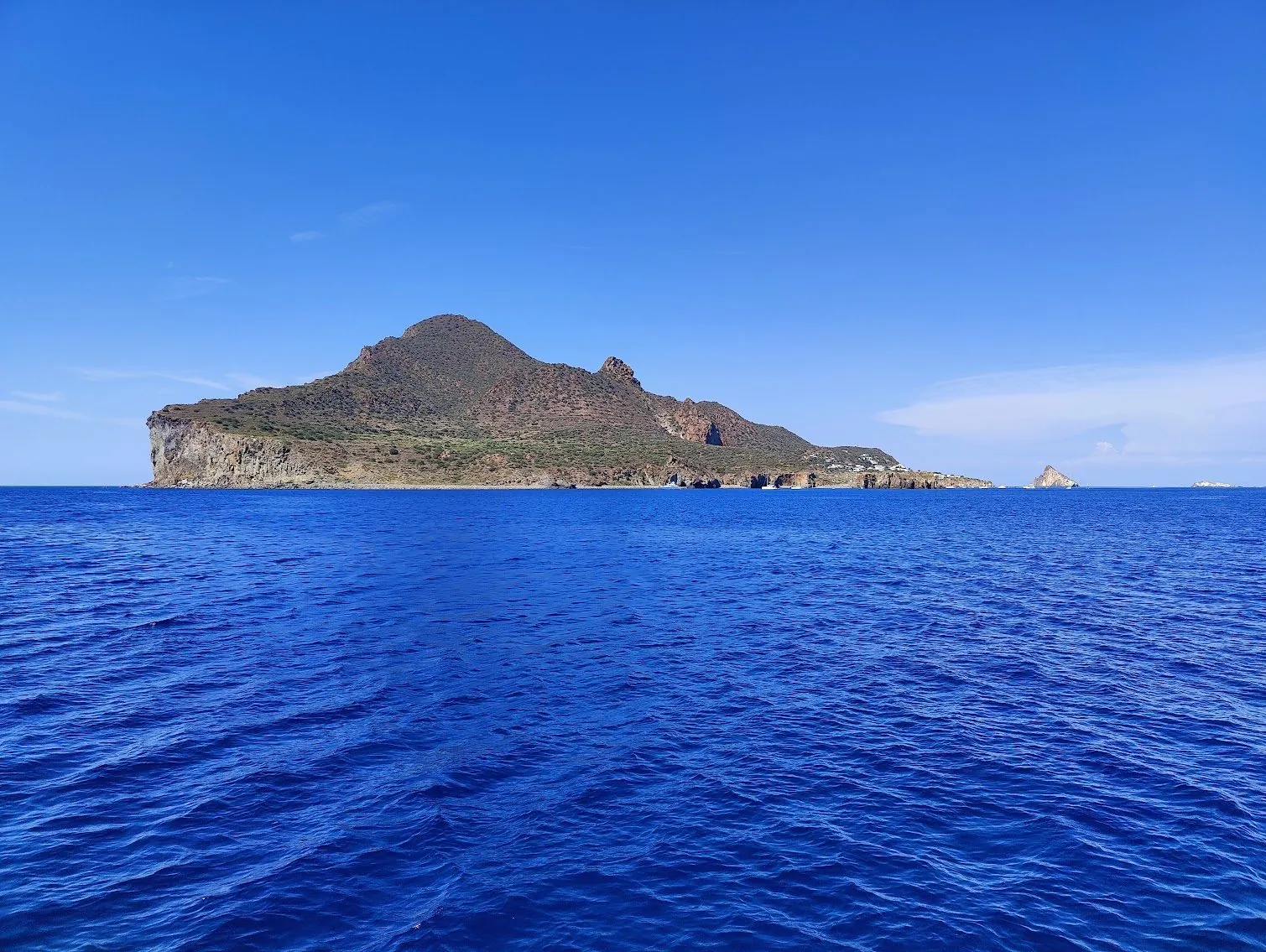
A slab of uninhabited volcanic rock rising from the water northeast of Panarea, inside the protected area. It stands in for the wildest stops of the journey: no houses, no roads, no sign of anyone.
By sea only, and no landing. It sits in a reserve: you approach by boat and coast along it, you do not step ashore.
The fortified rock that commands the harbour and the whole archipelago, layered with thousands of years of occupations built on top of each other. It is the only Aeolian set that sits inside a town.
On foot. You walk up from the centre of Lipari: the one location you can see without getting on a boat.
The shoot was closed to the public and the production has not released an official scene by scene map. The places above are the ones consistently reported by local press and destination portals: we list them as such, without assigning a specific scene to any of them. Sources are at the bottom of this page.
How they line up
On the chart the four points are not equally spaced. Lipari and Vulcano sit close together, separated by a narrow stretch of water crossed in minutes: Pietra del Bagno, the Grotta del Cavallo and the Castle line up comfortably in a single day out of Lipari, with time left to swim.
Basiluzzo is a different matter. It lies off Panarea, much further north, and from Lipari that means a serious crossing. Most people pair it with Panarea and Stromboli on a dedicated day, or pick it up as a stop when sailing for several days. Squeezing it into the same run as the other three means spending the whole day underway and never stopping.
The practical advice is to split it: one day around Lipari and Vulcano for three locations out of four, and a second day towards Panarea if Basiluzzo really matters to you. With only one day available, the first of the two gives you far more.
The average market price we see for leaving from Lipari, which is the natural base for three locations out of four.
These are average market prices: we track the published rates across the islands, and the figures vary with season and availability. They rise in August. Fuel is almost always charged separately. Ask us for a tailored quote, at no cost to you.
When it actually works
There is an irony here worth knowing before you book. The Aeolian shoot ran in April, which of the workable months is the roughest: typical April wind in the Aeolians touches 13 knots and strong wind days run to more than five a month. A production with ten ships and weeks of schedule can absorb that. You, with one day and a sea cave to visit, cannot.
Because the Grotta del Cavallo can only be entered in calm water, and Basiluzzo is awkward to approach in any swell. These are the average winds of the last thirty years at Lipari, month by month.
| Month | Typical wind | Strong days per month |
|---|---|---|
| April | 13.1 knots | around 5 |
| May | 10.9 knots | around 3 |
| June | 9.1 knots | under 1 |
| July | 8.6 knots | under 1 |
| August | 8.1 knots | under 1 |
| September | 10.0 knots | around 2 to 3 |
| October | 10.7 knots | around 3 |
From June to August the sea lets you through almost every day: fewer than one strong wind day a month. These remain thirty year averages, not a forecast: on the morning of your trip the day's weather decides, and a serious skipper cancels and refunds when the sea does not allow it. Weather data ERA5 via Open-Meteo, Deutscher Wetterdienst, CC BY 4.0.
What people ask us
The Aeolian shoot took place in April 2025 across Lipari, Vulcano and Panarea. The places reported are Pietra del Bagno and Lipari Castle, the Grotta del Cavallo on Vulcano and the islet of Basiluzzo off Panarea. Pignataro harbour on Lipari served as the production base.
Most of them only from the water. The Grotta del Cavallo on Vulcano is reachable only by sea, Basiluzzo is an uninhabited islet inside a protected area that you approach without landing, and Pietra del Bagno is a rock offshore from Lipari. The only one you can walk to is Lipari Castle, which sits in town. For the others you need a boat: a skippered boat, a place on a shared tour, or a small dinghy you drive yourself.
Leaving from Lipari, a private boat with a skipper for the full day averages around 450 euro, a small boat you drive yourself around 190 euro, and a place on a shared tour starts at around 55 euro per person, though shared tours follow a fixed route that rarely takes in these places. These are average market prices that vary with season and availability, and they rise in August.
Not for a dinghy up to 40hp, which you can drive yourself within the distance limits set by Italian law, with no Italian licence required. Anything larger needs a licence or a skipper on board. Most visitors from abroad take a skippered boat or a shared tour, which also means the navigation is handled by someone who knows the caves and the anchorages.
Between June and August. In those months the typical wind sits around 8 or 9 knots and strong wind days are fewer than one a month, so caves and islets are almost always approachable. In April, the month of the shoot, typical wind rises above 13 knots with around five strong days: dramatic to watch, far less convenient for entering a sea cave.
Where you start from
The usual choice for visitors from abroad: no licence needed, and the person at the helm knows which caves are workable today.
See skippered boats →What a boat costs across the islands, by format and by departure port, with the average market figures we track.
See the prices →Up to 40hp you drive it yourself with no Italian licence. The format that gets closest to the rock, and the cheapest for a small group.
See dinghy rental →Where this comes from
This page is not connected to the film's production or its distributors, and sells no tickets or set visits. It explains where those places are and how you reach them by boat, which is the work we do.
Next step
Send us the date, how many of you there are and which island you are staying on: we reply with the options that actually take in these points, at the current price, no strings attached and at no cost to you.
Get a free quote